HR for Small Teams Is a Quotidian Tangle
For most Indian startups and small businesses, managing HR is a workaday struggle held together with spreadsheets, email threads, and paper files. Offer letters drafted from scratch each time. Payroll tracked manually. Attendance logged on notepads. When a business grows from five people to fifty, that patchwork arrangement buckles under its own weight.
Enterprise HR tools existed, but they were cumbersome to configure, priced for companies with dedicated IT teams, and built around assumptions that simply did not fit a lean, fast-moving business. There was a genuine gap in the Indian market for something purpose-built for this segment: affordable, legally compliant with Indian labor regulations, and tractable enough that a founder or office manager could use it without prior training.
Offrd Inc. was founded to close that gap. They brought in Sequoia Applied Technologies as their engineering partner to design and build the platform from the ground up.
Building the Platform End to End
Sequoia Applied Technologies is a Santa Clara, California software engineering firm that builds cloud platforms, embedded systems, and IoT products for technology companies across life sciences, cleantech, and enterprise software. The Offrd engagement was a full product build, from architecture decisions through production delivery.
Sequoia's engineering team worked closely with the Offrd founders to turn a well-defined product brief into a working system. The requirements were clear from the start: fast to set up, compliant with Indian statutory rules, usable without any onboarding support, and priced in a way that would not penalize small businesses for occasional use.
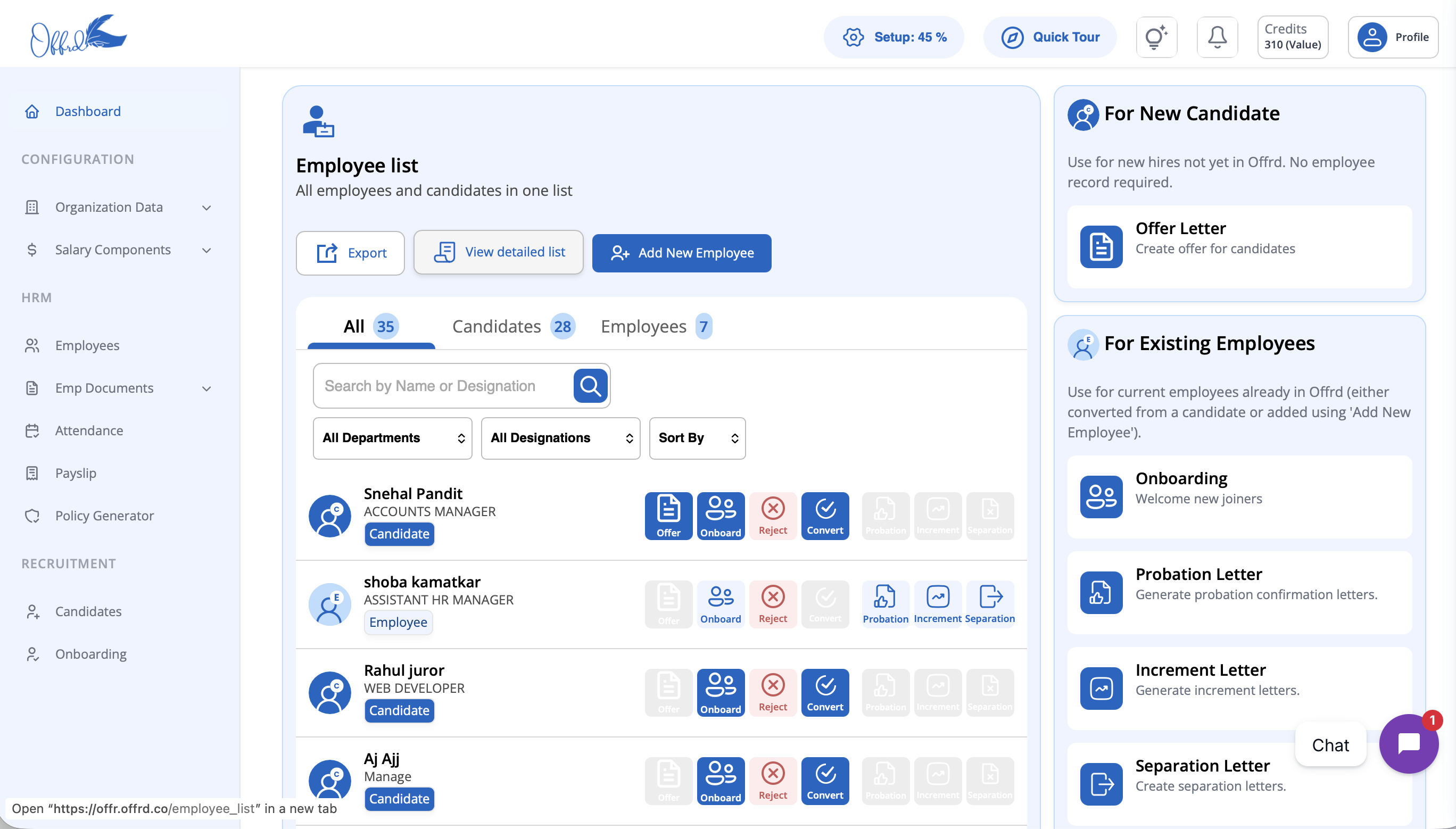
What came out of that work is offrd.co, a cloud HR platform that handles everything from offer letters through separation. Companies can generate offer letters, probation confirmations, increment letters, and separation documents from compliant templates in under two minutes. Onboarding workflows collect employee data and documentation automatically. Payslips are produced with statutory deductions applied, and payroll runs without requiring manual steps each cycle.
Attendance tracking works through QR code scanning and geofencing via a mobile app, with no additional hardware required. AI-assisted features handle document drafting and repetitive workflow steps. A central employee database gives HR managers a clear view of headcount, attrition, and compliance status across all their offices.
Multi-tenant SaaS Architecture on AWS Serverless
The architecture was shaped by two constraints that were fixed from the first technical conversation: it had to support thousands of separate companies from a single system, and the infrastructure cost had to stay proportional to actual usage rather than running idle.
The system was designed as a multi-tenant platform from the start. A single application instance serves all customers, with strict data separation between accounts enforced at every layer. This shaped database schema design, access control logic, and document storage from the very first decisions. Adding it later would have meant rebuilding the foundation.
React powers the user interface, keeping the experience consistent across desktop and mobile. The design prioritizes speed: most tasks complete in a few clicks, and the interface requires no technical familiarity to navigate.
Python handles the server-side logic: document generation, payroll calculations, statutory deduction rules, and data processing. The backend was built around the compliance requirements specific to Indian labor law.
The platform runs on AWS. Serverless compute handles event-driven workloads well, particularly document generation, notification dispatch, and payroll runs, where demand arrives in short bursts rather than a continuous stream.
The pay-per-use model required careful thought at the architecture level. Usage metering, billing hooks, and access gating were built to work reliably at scale without creating friction in the daily user experience.
Designing for serverless kept infrastructure costs commensurate with real demand. A company that runs one payroll cycle a month does not pay for idle compute. That kind of cost discipline was apposite for a platform serving businesses that are themselves watching every rupee.
A Platform That Now Serves 4,000+ Companies Across India
The platform went from product brief to a live, multi-tenant system that has since grown to serve over 4,000 companies, from early-stage startups to growing enterprises across the country. It carries strong ratings on independent software review platforms and has built most of its user base through word of mouth rather than paid advertising.
For a product built specifically for businesses that often have no dedicated HR function, that kind of organic adoption is a reasonable indicator of how well the underlying system holds up under real-world conditions. Customers have noted the absence of a setup process, the responsiveness of the support team, and the fact that the pricing model does not lock them into anything they are not using.
For Sequoia, this is the kind of engagement we do well. A clear problem, a considered architecture, and a system that has held up under real production conditions. If you are working on something similar, we are glad to talk through it.
Common Questions About This Engagement
What technology stack did Sequoia use to build the Offrd HR platform?
React for the frontend, Python for backend logic including payroll calculations and document generation, and AWS serverless infrastructure for hosting. The platform uses a multi-tenant architecture that serves thousands of independent companies from a single system.
How does Sequoia approach multi-tenant SaaS architecture?
Data separation between accounts is enforced at every layer, including database schema design, access control logic, and document storage. A single application instance serves all customers, which keeps infrastructure costs proportional to actual usage rather than idle capacity.
Can Sequoia build SaaS platforms that handle Indian labor law compliance?
Yes. The Offrd platform handles Indian statutory deduction rules in payroll, generates legally compliant HR documents, and manages employee records in alignment with Indian labor regulations. Those requirements were built into the backend architecture from the start, not retrofitted.
What kind of companies does Sequoia Applied Technologies work with?
Sequoia Applied Technologies is a Santa Clara, California software engineering firm that works with product companies across life sciences, cleantech, enterprise software, embedded systems, and IoT. Engagements typically cover full-stack development, cloud architecture, and production delivery.